
Is Amazon still the low-cost entry into the parcel shipping market?

With Amazon first making waves and fully diving deep into the parcel industry in 2026, a lot has changed, including Amazon starting to follow suit with the other two dominant carriers, UPS and FedEx.
Amazon’s 2027 6.1% Shipping Rate Increase and When Does It Take Effect?
Amazon Shipping has officially published its 2027 rate structure, locking in an overall average rate increase of 6.1%. As we assess these changes in November 2026, enterprise shippers and direct-to-consumer (DTC) brands must prepare for these adjustments before they take effect in early January 2027.
The headline figure of 6.1% conceals significant variations across specific weight tiers. While heavy parcels and commercial freight moving through the network absorb adjustments close to the baseline 6.1%, Amazon’s weight-break structure disproportionately impacts lightweight volume. Parcels weighing between 1 and 5 pounds—the primary profile for consumer retail, cosmetics, small electronics, and apparel—face adjustments approaching 6.5%.
This divergence reflects Amazon’s effort to address elevated line-haul, middle-mile, and final-mile delivery costs across its dedicated parcel operation. In recent years, Amazon Shipping has transitioned from a captive internal logistics system into a full-scale commercial parcel delivery service, directly competing against national carriers for volume originating off-Amazon.
Because light packages generate lower base revenue while occupying critical van cube, Amazon has structured this adjustment to protect operating yields on high-velocity ground shipments. For businesses shipping thousands of residential small parcels each week, modeling costs against the 6.1% headline figure will understate actual invoice exposure.
How Do the 2026–2027 Peak Season Surcharges and Fuel Fees Stack Up?
Before the 2027 standard rate card takes effect, shippers must navigate the 2026–2027 holiday demand surcharges. Amazon Shipping has structured its peak season into a three-stage calendar running from October 25, 2026, through January 16, 2027.
Across all stages, the standard per-package peak demand fee rose 25.0% year over year:
- Shoulder Window 1 (October 25 to November 21, 2026): Packages carry an additional demand surcharge of $0.50 per parcel (up from $0.40 in 2025).
- Core Holiday Peak (November 22 to December 26, 2026): The demand fee increases to $0.75 per parcel (up from $0.60 in 2025).
- Shoulder Window 2 (December 27, 2026 to January 16, 2027): Surcharges revert to the shoulder tier of $0.50 per parcel as post-holiday returns and late-season volume clear the hubs.
These demand adjustments are additive to base contracted rates and do not replace existing accessorials. Shippers must also track the ongoing 3.5% fuel and logistics surcharge introduced in April 2026. This 3.5% assessment applies to the total transportation cost, stacking on top of peak demand surcharges and base rates.
When evaluating these compounding costs, consult the official Amazon Shipping peak surcharge schedule and review how Amazon Shipping preps higher peak season surcharges across varying package profiles.
| Surcharge Type | 2025 Surcharge (Shoulder) | 2026–2027 Shoulder Rate | YoY Change (%) | 2025 Surcharge (Peak) | 2026–2027 Peak Rate | YoY Change (%) |
|---|---|---|---|---|---|---|
| Per-Package Demand Fee | $0.40 | $0.50 | +25.0% | $0.60 | $0.75 | +25.0% |
| Additional Handling Fee | $8.25 | $8.75 | +6.1% | $10.80 | $11.90 | +10.2% |
| Large Package Surcharge | $90.00 | $96.25 | +6.9% | $107.00 | $117.50 | +9.8% |
| Extra Heavy Package Fee | $485.00 | $530.00 | +9.3% | $540.00 | $590.00 | +9.3% |
What Are the Specific Accessorial Fee Thresholds for Peak 2026–2027?
While the per-package fee applies to all parcels, non-standard items incur significant accessorial charges during peak periods:
- Additional Handling: Charged on parcels with non-standard dimensions, non-corrugated packaging, or weights exceeding defined carrier thresholds. This fee rises from a baseline to $8.75 during shoulder windows (+6.1% year over year) and increases to $11.90 during the core holiday stretch (+10.2% year over year).
- Large Package Surcharge: Applied to items crossing carrier cubic and length-plus-girth boundaries. The fee increases to $96.25 in shoulder periods (+6.9% year over year) and $117.50 during peak weeks (+9.8% year over year).
- Extra Heavy Package Fee: Designed to deter heavy freight from entering the package network. This assessment steps up 9.3% to $530.00 during shoulder dates and $590.00 during the core peak period.
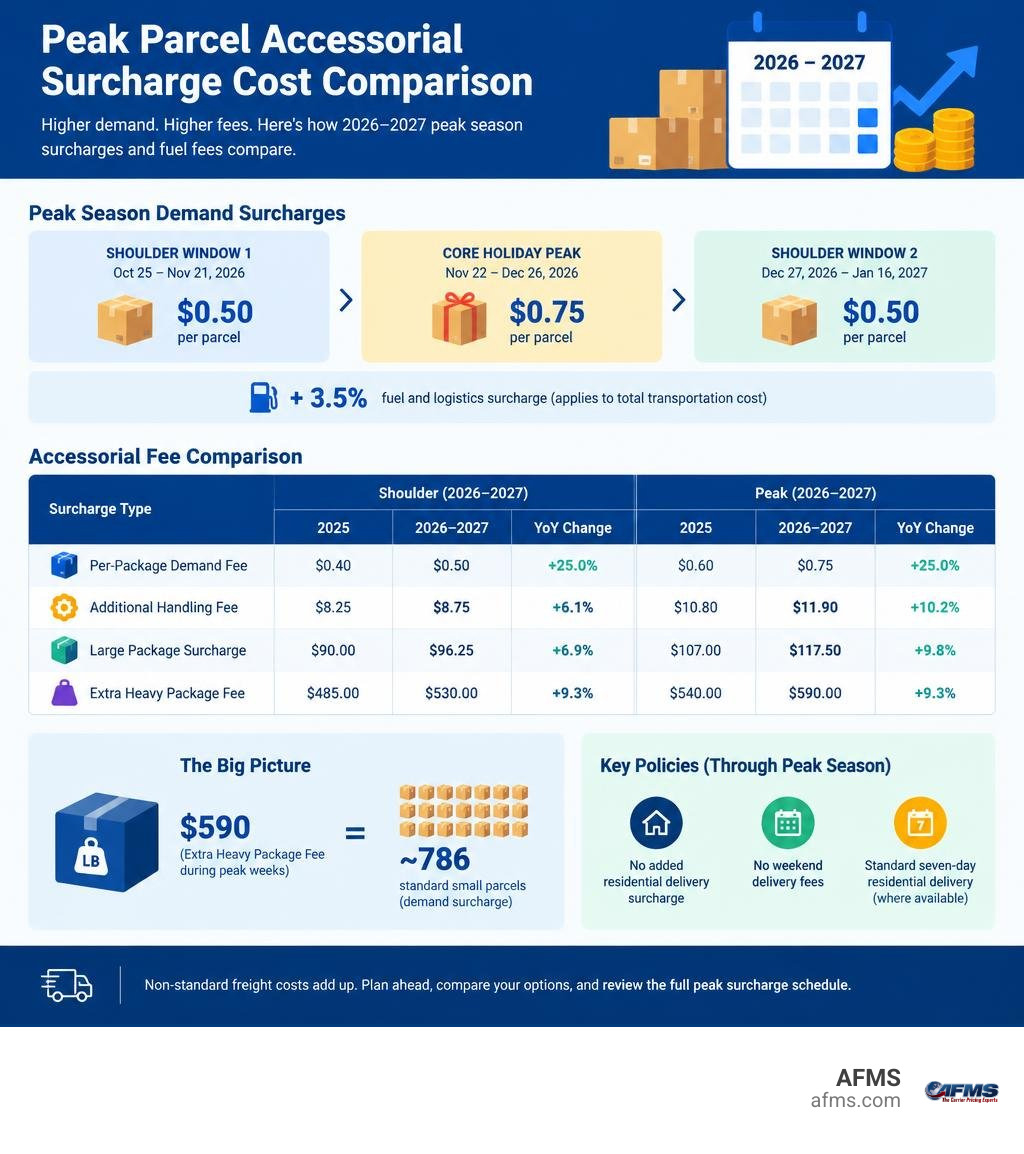
The financial impact of non-standard freight is substantial: dispatching a single Extra Heavy parcel during peak weeks ($590.00) matches the demand surcharge cost of moving roughly 786 standard small parcels during the same timeframe.
Despite these increases, Amazon Shipping maintains several key operational policies through peak season: no added residential delivery surcharge, no weekend delivery fees, and standard seven-day residential delivery capabilities where local network density allows.
How Does Amazon Shipping Compare to Other Major Carriers for 2027?
Comparing Amazon Shipping’s 2027 adjustments with legacy national carriers shows that while headline general rate increases (GRIs) appear aligned, the operational surcharge mechanisms differ considerably.

Legacy parcel carriers have established standard list rate increases averaging 5.9%. One major national carrier’s 5.9% general rate increase takes effect on January 4, 2027, along with zone reclassifications and paper processing penalties. Another legacy competitor implements its 5.9% daily rate hike on December 21, 2026, while expanding its Additional Handling minimum billable weight threshold from 40 to 50 pounds. Postal services have also utilized temporary holiday rate hikes—up to 8%—running through January 17, 2027, before converting them into structural transportation adjustments.
The primary difference lies in surcharge architecture:
- Demand Surcharge Format: Amazon Shipping enforces a predictable flat per-package fee ($0.50 or $0.75). Legacy carriers utilize dynamic, tiered models calculated from historical shipping baselines, often reaching $1.50 to $2.50 or more per parcel for high-volume accounts exceeding seasonal limits.
- Residential Surcharges: Legacy carriers assess base residential fees between $6.45 and $7.10 per parcel before fuel surcharges. In contrast, Amazon Shipping’s published rates include residential ground delivery without an added baseline charge.
- Delivery Area Surcharges (DAS): Legacy carriers periodically reclassify ZIP codes, shifting thousands of locations into Extended or Remote delivery tiers where surcharges can exceed $17.00 per package. Amazon Shipping utilizes unified ground pricing across its domestic pickup and delivery footprint.
Review the carrier’s baseline transparent ground shipping rates against legacy carrier contracts to determine where route density offsets rate card differences.
| Metric / Surcharge Element | Amazon Shipping (2027) | Legacy Carrier A (Jan 2027) | Legacy Carrier B (Dec 2026) |
|---|---|---|---|
| Headline General Rate Increase | 6.1% overall average | 5.9% standard list average | 5.9% daily rate average |
| Small Parcel (1–5 lb) Base Rate Trend | Increasing ~6.5% | Increasing 6.1% to 6.5% | Increasing 6.0% to 6.6% |
| Standard Residential Surcharge | $0.00 (Waived) | $6.90 (+7.0%) | $7.10 (+9.2%) |
| Peak Demand Surcharge Type | Flat $0.50 / $0.75 per package | Tiered / Volume-pegged ($0.50–$2.50+) | Tiered / Volume-pegged ($0.50–$2.50+) |
| Delivery Area Surcharge (DAS) | Not assessed across coverage areas | $5.55 to $17.75+ (ZIP reclassified) | $5.75 to $18.00+ (ZIP remapped) |
| Weekend Delivery Assessment | Included in standard schedule | Added fees for commercial/scheduled | Added fees for Saturday ground |
| Fuel Surcharge Structure | Flat 3.5% fuel & logistics fee | Weekly index table (ranging 15–20%+) | Weekly index table (ranging 15–20%+) |
How Do FBA Fee Revisions and AWD Surcharges Intersect with Amazon Shipping?
To manage fulfillment costs effectively, shippers must distinguish between Amazon Shipping—a commercial parcel transportation carrier—and marketplace-driven logistics such as Fulfillment by Amazon (FBA), Amazon Warehousing and Distribution (AWD), and Multi-Channel Fulfillment (MCF).
FBA sellers navigated separate holiday fulfillment surcharges between October 15, 2026, and January 14, 2027, which averaged an additional $0.32 per unit. Looking ahead to 2027, Amazon has outlined structural changes via the official 2027 US Referral and FBA fulfillment fee updates:
- Fulfillment Base Fee Increases: Effective January 15, 2027, standard FBA fulfillment fees will increase by an average of $0.19 per unit sold (approximately 0.8% of the average selling price). Actual adjustments vary by size tier and price:
- Small standard-size (under $10): Increases by an average of $0.20.
- Small standard-size ($10 to $50): Increases by an average of $0.40.
- Small standard-size (above $50): Increases by an average of $0.70.
- Large standard-size (under $10): No base rate change.
- Large standard-size ($10 to $50): Increases by an average of $0.12.
- Large standard-size (above $50): Increases by an average of $0.47.
- Expanding Fuel Surcharges: The expansion of Amazon’s fuel and logistics surcharge takes effect February 1, 2027. The ongoing 3.5% fee will expand to U.S. transportation legs for Amazon Warehousing and Distribution (AWD) and Multi-Channel Distribution (MCD).
- Compounding Freight Costs: Under this structure, an inventory unit routed through AWD into an FBA hub for final customer delivery can carry the 3.5% surcharge twice: first on AWD bulk transfer transportation, and again on final customer fulfillment.
- Storage Fee Simplification: Effective February 1, 2027, Amazon will eliminate the storage utilization surcharge and combine aged inventory surcharges (for goods stored over 180 days) with standard monthly storage fees into a single age-based schedule.
- Inventory Level Penalties: The low-inventory-level fee will apply only when stock drops below 28 days of forward-looking supply, calculated using historical and projected four-week shipment metrics.
- Off-Marketplace Fulfillment (MCF): Adjustments detailed in the Multi-Channel Fulfillment pricing updates take effect January 15, 2027, including an average 3.5% fee adjustment on standard-speed orders, a returns processing surcharge on boxed returns, and alignment of MCF size tiers with FBA standards.
Which Shipment Profiles and Package Types Will See the Highest Cost Impact?
The combination of base rate hikes, dimensional weight rules, and accessorial thresholds means certain shipping profiles will absorb disproportionate cost increases entering 2027.

- Lightweight E-Commerce Shipments (1 to 5 Pounds): With base rate increases reaching 6.5% in this segment, high-volume apparel, nutrition, and consumer goods brands will face adjustments above the 6.1% headline rate.
- Low Average Selling Price (ASP) Inventory: Products retailing below $15 with low margins are sensitive to fee increases. An item with an 8% net margin can see profitability halved when absorbing an added $0.19 fulfillment increase alongside 3.5% fuel assessments and peak surcharges.
- Bulky, Low-Density Merchandise: Shippers operating without packaging optimization frequently trigger strict carrier dimensional weight pricing rules. Outer cartons that exceed cubic thresholds incur Additional Handling ($11.90 peak) or Large Package fees ($117.50 peak), shifting landed unit economics.
- Multi-Leg Replenishment Operations: Businesses utilizing AWD for pallet staging that regularly transfer inventory to FBA fulfillment centers or merchant warehouses will incur the 3.5% logistics surcharge on intermediate freight legs starting February 1, 2027.
- Orders Shipped Across Price Boundaries: Because Amazon calculates fulfillment fees when orders are fulfilled rather than at checkout, units purchased near mid-January or mid-October cutoff dates are billed at the higher prevailing rate if fulfillment occurs after transition deadlines.
How Can Businesses Mitigate Rising Rates and Optimize Carrier Contracts?
Managing the 2027 rate increases requires operational packaging controls and contract management across your carrier portfolio.
Cartonization and Dimension Auditing
Accessorial fees scale faster than standard base rates. Shippers should evaluate packaging dimensions to ensure master cartons and individual mailers do not trigger Additional Handling or Large Package thresholds. Reducing outer dimensions by a fraction of an inch can prevent a carton from crossing cubic thresholds, avoiding an $11.90 peak handling charge or $117.50 large package fee.
Multi-Carrier Routing Architecture
Amazon Shipping provides clear value for dense, business-to-consumer ground residential shipments because it does not assess standard residential fees or delivery area surcharges. However, legacy carriers may offer better pricing on dense commercial shipments, short-zone moves, or deferred regional delivery. Implementing automated multi-carrier rating logic lets you direct parcels to the most cost-effective carrier based on total landed cost rather than base rate alone. Review our operational guide on best practices to reduce shipping costs to benchmark carrier routing.
Data-Driven Carrier Benchmarking
Relying on carrier-provided headline figures will obscure your actual cost adjustments. Businesses should model historical shipping manifests against new 2027 rate matrices and accessorial schedules. Contract modeling must account for minimum floor charges, index-linked fuel tables, and seasonal demand surcharges.
At AFMS, we support enterprise shippers across the United States, Canada, Europe, and Asia by providing contract negotiation advisory, billing audits, and carrier benchmarking. With more than 30 years of supply chain analytics and over $4.5 billion secured in verified client savings, our teams help you analyze rate changes and address carrier margins.
You can initiate this review with a free parcel assessment to identify billing variances, examine accessorial exposure, and develop contract negotiation strategies.
Frequently Asked Questions About the Amazon Shipping 2027 Rate Increase
When Do the 2027 Amazon Shipping Base Rates and Peak Surcharges Take Effect?
Amazon Shipping’s peak demand surcharges apply from October 25, 2026, through January 16, 2027, with the highest fees charged between November 22 and December 26, 2026. The 2027 commercial base rate adjustments take effect in early January 2027. Related fulfillment updates, such as revised FBA fulfillment fees, take effect January 15, 2027, followed by the AWD fuel surcharge expansion on February 1, 2027.
Does Amazon Shipping Charge Extra for Residential Deliveries or Weekend Pickups?
No. Amazon Shipping does not assess standard residential surcharges, delivery area surcharges (DAS), or weekend delivery fees. Seven-day residential pickup and delivery services are included in standard pricing, subject to regional network coverage.
How Does the 3.5% Fuel and Logistics Surcharge Function Across Services?
Introduced in April 2026 to offset elevated fuel and middle-mile linehaul inflation, the flat 3.5% fee applies to the net base transportation rate and demand surcharges for Amazon Shipping. It also applies to FBA fulfillment fees and will expand to U.S. transportation for Amazon Warehousing and Distribution (AWD) and Multi-Channel Distribution (MCD) beginning February 1, 2027.
What Strategic Steps Should Shippers Take Next to Protect Margins?
The shipping environment entering 2027 reflects widespread price adjustments. Between Amazon Shipping’s 6.1% base rate increase, higher peak demand fees, expanding 3.5% logistics surcharges, and parallel 5.9% increases from legacy parcel carriers, shipping costs are increasing across networks.
- Recalculate Landed Unit Costs Immediately: Update product-level margin models with actual rate tables rather than baseline 6.1% or 5.9% assumptions, paying close attention to 1-to-5-pound packages.
- Audit Outer Packaging: Eliminate excessive dimensional weight and confirm standard parcel dimensions fall below carrier accessorial thresholds.
- Align Carrier Selection with Profile Strengths: Route residential e-commerce volume to take advantage of Amazon Shipping’s fee structure where feasible, while using regional or legacy carriers for commercial freight.
- Negotiate from Manifest Data: Engage carrier pricing teams with verified shipping data, lane balance metrics, and independent market benchmarks.
For a look at how these new rate increases will impact your specific carrier agreements and shipping budget, let the AFMS team of carrier pricing experts help provide you with a No Risk-No Fee review.
Call AFMS at (800) 246-3521 or write us at info@afms.com.